
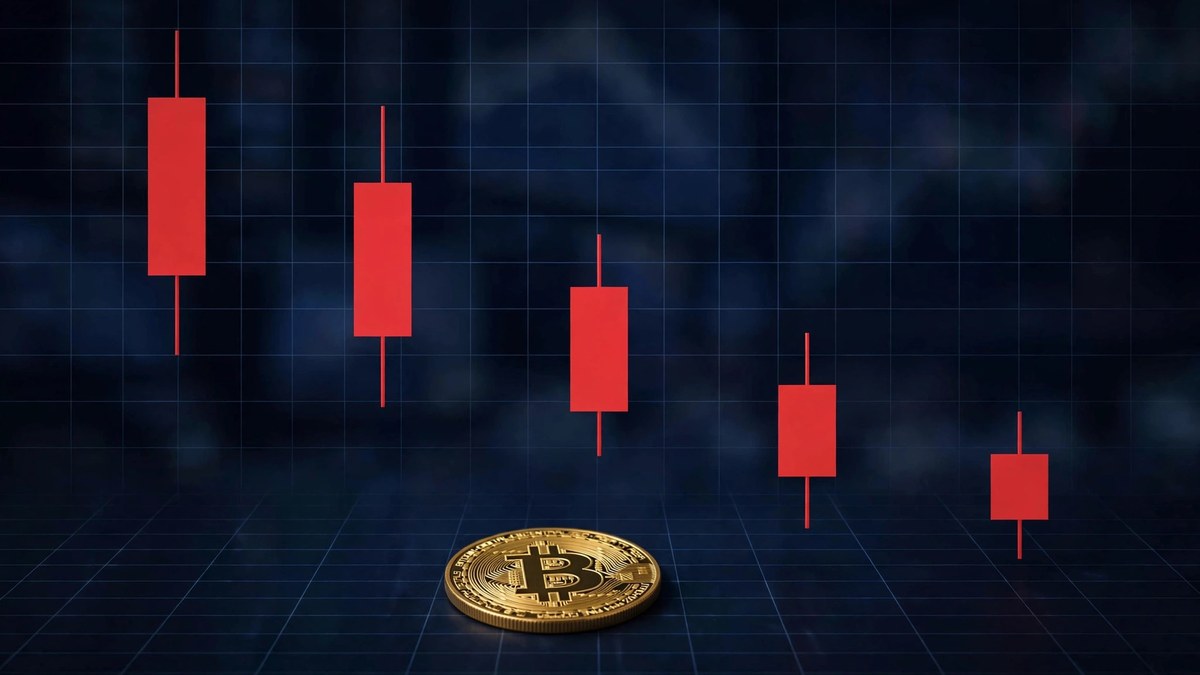
It’s official, and it’s worse than it looked on Sunday afternoon. The bitcoin fifth consecutive weekly loss is now confirmed: Bitcoin closed the week at $74,754 on Coinbase, down 4.45% from Monday’s open of $78,232. That’s five straight red weeks — a streak Bitcoin has only managed twice before since 2017. And this week was the biggest drop of the five.
Step back and the picture is striking. Five weeks ago, Bitcoin was trading around $86,500. Today it’s around $74,750. That’s a 13.6% slide, done not in one dramatic crash but in five small, steady weekly losses: 3.27%, then 2.00%, then 2.38%, then 2.28%, and now 4.45%. Nobody panicked. Nobody capitulated. The market just bled, a little at a time, every single week.
In this article
Bitcoin fifth consecutive weekly loss: the week in numbers
The week’s range tells you how it played out. Bitcoin touched roughly $81,000 on Wednesday, November 4 — a post-midterms bounce that lasted about as long as a tweet — and then gave it all back and more, sliding to a low of $73,477 on Coinbase late Sunday night. The final close of $74,754 came after a small recovery from that low, but the recovery didn’t change the story: the week ended 4.45% lower, the worst weekly fall of the run.
There’s another line that matters. Bitcoin also closed below its 50-week moving average — around $75,488 — for the first time in eight weeks. Long-term trend watchers treat that average as the line between a healthy uptrend and a market that’s lost its way. Crossing below it doesn’t guarantee more downside, but it does mean the bulls have lost their favourite talking point. The “Bitcoin always holds the 50-week” crowd is quiet this week.
And the company Bitcoin keeps in this streak is not encouraging. Five straight weekly losses has happened only twice before since 2017 — both times in markets that were already well into a downturn. History doesn’t have to repeat, but it’s not a coincidence that the only other times this happened, the market was already in trouble.
Why a grind hurts more than a crash
Here’s the thing about a slow bleed: it does something a crash can’t. A crash scares people into selling, and then it’s over — the sellers are gone, the buyers step in, and the market finds a floor. A grind does the opposite. Every week, a few more holders look at their portfolio, do the maths, and decide they’ve had enough. The selling never comes in a wave, so there’s never a moment of capitulation to mark the bottom. It just keeps going.
The ETF flows back that up. US spot Bitcoin ETFs lost $1.28 billion last week — their worst week since June — and BlackRock’s IBIT accounted for almost all of it. These are not retail traders panic-selling on their phones. These are institutions, methodically reducing exposure, week after week. The same institutions that were supposed to be the permanent bid.
Meanwhile, the news flow keeps working against the bulls. The midterms changed the political maths in Washington, the CLARITY Act is stuck, and October CPI lands on Tuesday at 8:30 AM ET. A hot print would make the Fed’s December decision harder, and rate-cut hopes have been one of the few things holding risk assets up.
What would break the streak
Two things, and they’re both simple. First, a green week — any green week. It doesn’t need to be big. A 1% gain next week would end the streak and give the market something to build on. Second, ETF flows turning positive. The flows have been the story all year, and one or two green days from IBIT would do more for sentiment than any chart pattern.
Until then, the honest read is this: Bitcoin is in its third five-week losing streak since 2017, it’s below its 50-week average, and it’s down 13.6% from where this slide started. The losses are small enough that nobody’s panicking — and that’s exactly what makes it a grind instead of a panic. Grinds end when buyers show up, not when sellers get tired. So far, the buyers haven’t shown up.
Sources: Bitcoin Insider: Bitcoin fifth weekly loss confirmed; CoinMarketCap: Bitcoin must regain 50-week average.
This article is for education only — not financial advice. Crypto is volatile, so do your own research before buying anything.




Leave a Reply